




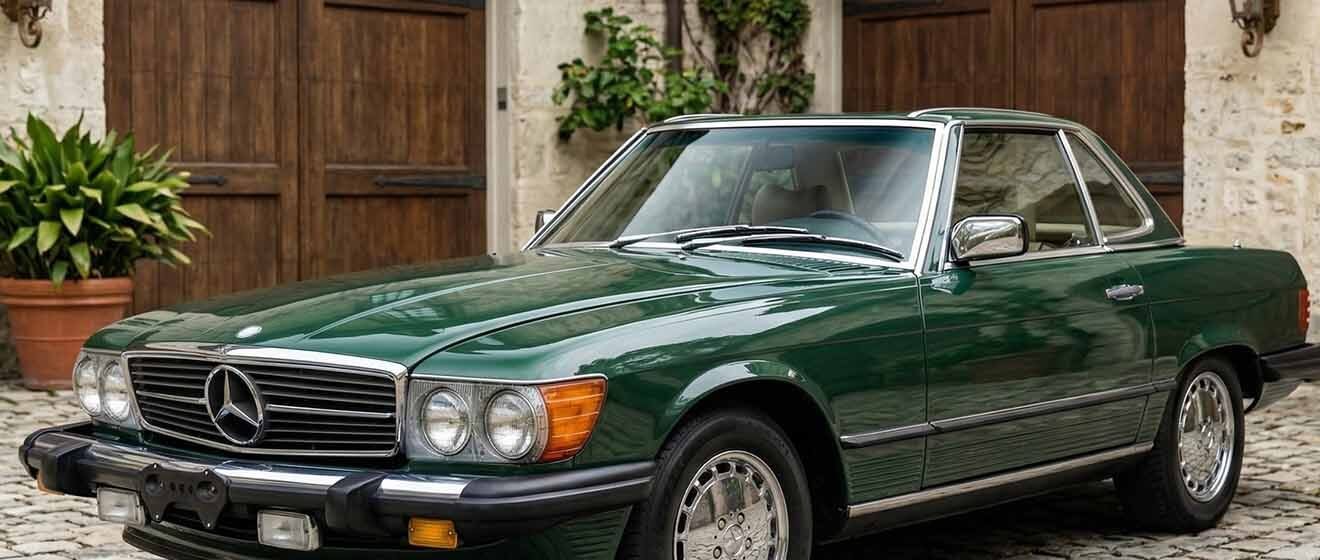
Searching for the right parts costs every classic car mechanic many man-hours. And if, on top of that, the right part cannot be found anywhere, that is wasted time. And time is what every classic car garage is currently short on. Fortunately, we have found a good solution for a number of Mercedes-Benz “Out of Stock” parts.
Camshaft 380 SL A1160516301 no longer available from Mercedes-Benz
More and more parts for Mercedes-Benz classics and vintage cars are no longer available. And we need to find a good, workable solution for that. For instance, it recently turned out that the long camshaft for the right side of an R107 380 SL USA, the A1160516301, is no longer available from Mercedes-Benz. After a long search, we found a company that can manufacture this camshaft specifically for us in good quality. As a result, we now have the A1160516301 and A1160516201 camshafts in stock, and the problem is back under control.
European 380 engines with the A1160517101 now also in reproduction
We have also recently started reproducing the A1160517101, prefix number 1160516701. This camshaft is also located on the right side and can be found in, among others, the Japanese 380 engines. However, it is also found in European models with the 380 engine, such as the 380 SE, 380 SEC, 380 SEL, and 380 SL. For the 380 SL EU (long), the A1160516101 for the passenger side and the A1160516001 for the driver's side are currently being reproduced. These camshafts will also be produced in small quantities. If there is sufficient demand, camshafts can naturally be manufactured for other Mercedes-Benz classic car models as well. However, due to production in small numbers, the prices of these camshafts will be somewhat higher than you are accustomed to.
450SL long side the a1170510101
For the 450SL, the a1170510101 has now been reproduced and is in stock. This is the long camshaft for the right side.
What does the camshaft do and why does it break?
The camshaft has a rotating motion, driven by the crankshaft, and ensures that the engine valves open and close at the right moment so that air can flow in and out of the cylinder. Naturally, the camshaft ages initially through normal use. However, it is primarily damaged by a lack of proper lubrication due to problems with the oil gallery mounted above it. The oil gallery connecting pieces are made of plastic and must be replaced every 6 to 8 years. This oil gallery above the camshaft not only lubricates the cams but also lubricates the bearing housings in which the camshaft rotates. Continuing to drive with a broken camshaft can cause significant damage to the engine. For classic cars, it is important during major maintenance to also check the condition of the camshaft and to inspect the connecting pieces and replace them if necessary. Replacing the camshafts on time falls under necessary periodic maintenance and prevents serious engine damage in the long run.
How do you know if the camshaft needs to be replaced?
As soon as the cams are worn in and start to become rough, it is time to replace the camshaft. This rough surface is often clearly visible, but can also be easily felt with your fingernail. Once camshafts become rough, the wear process accelerates. When the time for replacement arrives, we face various choices that can have significant financial consequences. We often replace the camshafts “in the car” without removing the cylinder heads or the engine. However, there is a risk that the cylinder head gasket will leak, as the outer bolts of the camshaft bearing housings are cylinder head bolts. Often, space also needs to be created to loosen everything; for instance, the brake booster may need to be removed. Alternatively, the cylinder heads can be removed while still in the car, after which they can be planed and reassembled with new cylinder head bolts.
 Account
 categories
 Car filter
 To search
 Top
Top